Showing posts with label citrus. Show all posts

Wednesday, July 27, 2011

Exciting News!

Things have been very busy this summer and I have not had the time to blog as I would like to. Most of that is due to two things:

1) Growing our garden takes a lot of time. But recently even that has been neglected woefully because of the next reason:

2) We are moving! We will finally have a place to plant and grow a real garden, and we can hardly wait! We won't have to wait long, because we only have a month to fix up the new place, pack and move. Luckily, it's just across town.

I keep planning the landscape when I should be focusing on fixing up the house itself. My excuse: We can't do much until the flooring and paint is done, so in the meantime, why not dream up delicious homegrown produce and herbs?

There is a basic landscape in place, but most of the plants and trees have been torn out for some reason. All that remains is a yellow rose bush and a what appears to be a neglected dwarf orange tree:

I had a chance to ask the previous owner about this sad little tree, and she lamented that it had never produced fruit. So I have my work cut out for me, friends! The first thing I did was prune the tree, add compost, water it, and mulch it. It's looking better already and I am dreaming of oranges this winter (hope hope)! In my dreams, it's something like a miniature version of this:


Sunday, May 1, 2011

Lemon Bar Trifle & Recipe for a Perfect Birthday

Let us consider the ingredients of a perfect birthday celebration for one's spouse.

Step one: If your spouse can't get enough Mexican food, find a fantastic taco stand and take them there for lunch.
Squeeze the lime over the meat, then devour the freshly made tacos with relish.
Step two: Take your spouse somewhere exciting and exotic for dinner. Maybe eat some tapas and the best salad you ever had (dates in my salad? A wonderful idea! Who knew?) and pretend that you are on the streets of Barcelona together.
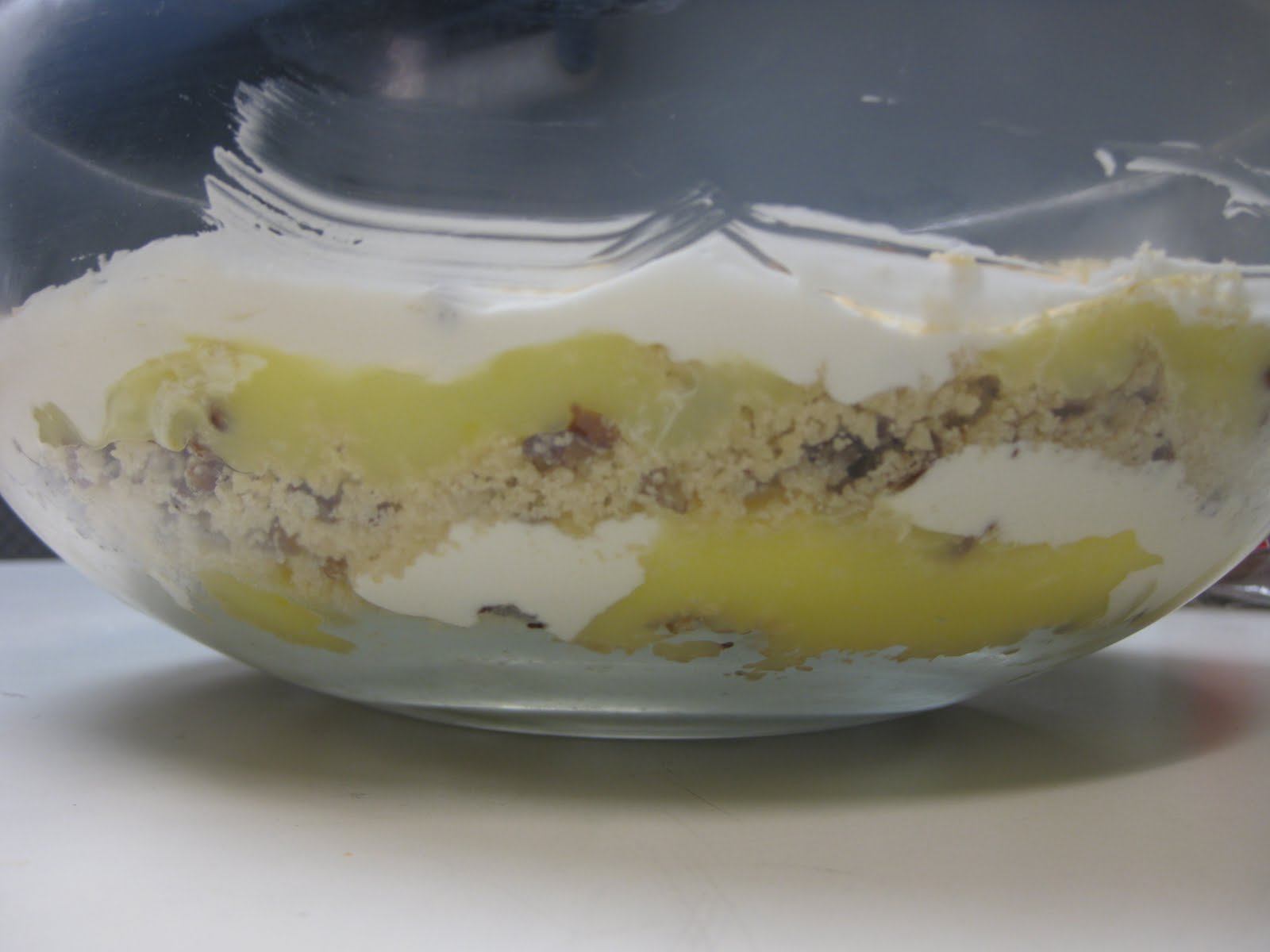
Step three: A wonderful dessert is requisite, and if your spouse loves lemon, how about a Lemon Bar Trifle with fresh lemon curd, pecan shortbread crumbs and white creaminess?

Step 4: When the whole family gets together to celebrate, make sure there are at least 3 kinds of pies to satisfy all appetites. The smile on your spouse's face will be all the reward you need.

There's the recipe I used for a happy birthday this time around. It was a winner. So was the Lemon Bar Trifle recipe, so here it is:


Lemon Bar Trifle


2 c. flour
1 c. pecans, chopped
1 c. butter, melted
1 1/2 c. sugar
1/4 c. cornstarch
1/4 c. flour
1 3/4 c. cold water
3 egg yolks, beaten
2/3 c. lemon juice
2 T. butter
4 tsp. lemon peel, grated
1 8-oz cream cheese, softened
3 C. powdered sugar
1 8-oz. container frozen whipped topping, thawed

In a small bowl, combine flour and pecans; stir in melted butter. Press into an ungreased 9x13 inch baking dish. Bake at 350 for 18-20 minutes or until light golden brown. Cool on a wire rack.

In a small heavy saucepan, combine the sugar, cornstarch, and flour. Stir in water until smooth. cook and stir over medium-high heat until thickened and bubbly. Reduce heat; cook and stir 2 minutes longer. Remove from heat. Stir a small amount of hot mixture into egg yolks; return all egg yolks to the pan, stirring constantly. Bring to a gentle boil; cook and stir 2 minutes longer. Remove from the heat. Gently stir in the lemon juice, butter, and lemon peel. transfer to a large bowl. Cool to room temperature without stirring. Cover surface with waxed paper; refrigerate until chilled.

In a large bowl, beat cream cheese and powdered sugar until smooth. Fold in whipped topping. Crumble the baked pecan mixture; set aside 1/2 c. for topping. Just before serving, in a 3-quart trifle bowl, layer 1 C. each pecan mixture, lemon mixture, and cream cheese mixture. Repeat layers 2 more times. Sprinkle with reserved pecan mixture. Refrigerate leftovers. Makes 9 servings.

Thursday, April 21, 2011

Lemon-Ginger Scones with Oat Flour

One year when I was in college, a roommate and native Utahn announced that some of her friends were coming over that night for a scone-making party. Apparently this was a long-standing tradition for them, and I was elated at this information. Why, this party sounded like something straight out of "Pride and Prejudice"! How British! How proper! I was all ready to bring the tradition of afternoon tea back to America with this little band of apparent Anglophiles.
When the friends showed up, they appeared to be congregating around a pot of boiling oil, much to my confusion. Later, when my roommate came and offered me a piece of fried dough sprinkled with cinnamon sugar, I was confused and disappointed. It was then that I learned that in some places like Utah and Idaho, the term "scone" is applied to what is called fry bread, fried dough, or elephant ears in other places, and looks like this:


It was a tasty snack, don't get me wrong, but don't expect me to ever apply the term "scone" to anything other than true British teatime scones. I'm a staunch traditionalist in this respect.


One of my favorite scone flavor combinations is lemon with crystallized ginger. Ever since I began cooking from Kim Boyce's "Good to the Grain" cookbook and realized how delicious whole grain flours can be, I find it hard to justify using all white flour in any recipe. So I tweaked a recipe for scones to include oat flour.


As you can see below, the scones are delicate; crunchy on the outside and soft inside, dotted with chunks of warm crystallized ginger and sprinkled with coarse sugar. Enjoy with with a cup of lemon ginger herbal tea and you'll be feeling British by breakfast.


Lemon and Ginger Scones

1 cup all-purpose flour
1 cup oat flour
1/4 cup granulated sugar
1 teaspoon baking powder
1/4 teaspoon baking soda
1/4 teaspoon sea salt
7 T. unsalted butter, cold and cut into pieces
1/2 cup crystallized ginger, chopped into small pieces
Zest of 1 large lemon
2/3 cup buttermilk (I substituted almond milk plus 1 tsp. lemon juice)
Coarse sugar to sprinkling on top

1. Preheat oven to 400 degrees F (200 degrees C) and place rack in middle of oven. Line a cookie sheet with parchment paper.
2. In a large bowl, whisk together the flours, sugar, baking powder, baking soda and salt. Cut the butter into small pieces and blend into the flour mixture with a pastry blender or two knives. The mixture should look like coarse crumbs. Stir in the chopped crystallized ginger and lemon zest. Add the buttermilk to the flour mixture and stir just until the dough comes together. Do not over mix the dough.
3. Transfer to a lightly floured surface and knead dough gently four or five times and then pat the dough into a circle that is about 7 inches (18 cm) round and about 11/2 inches (3.75 cm) thick. Cut this circle in half, then cut each half into 3 or 4 pie-shaped wedges (triangles). Place the scones on the baking sheet. Sprinkle tops with coarse sugar.
4. Bake for about 20 to 25 minutes or until golden brown and a toothpick inserted in the middle comes out clean. Transfer to a wire rack to cool.

Tuesday, February 15, 2011

When Life Gives You Lemons, Make Lemon Curd


I have a new mantra for you. When life gives you lemons, make lemon curd. A longtime favorite in England, lemon curd has in recent years begun popping up in everything from gourmet cupcakes to restaurant breakfast menus. When a friend gave us a bag of lemons, I researched making my own lemon curd at home and found that it's not to difficult - especially when you have Alton Brown to guide you.

Here's his simple recipe for lemon curd. I made a batch and for Valentines Day, I used it as a filling in mini puff pastry tarts, topped with a single fresh raspberry. They were adorable and my friends and co-workers went crazy for them. Enjoy!

Lemon Curd
Recipe from Alton Brown


5 egg yolks
1 cup sugar
4 lemons, zested and juiced
1 stick butter, cut into pats and chilled

Add enough water to a medium saucepan to come about 1-inch up the side. Bring to a simmer over medium-high heat. Meanwhile, combine egg yolks and sugar in a medium size metal bowl and whisk until smooth, about 1 minute. Measure citrus juice and if needed, add enough cold water to reach 1/3 cup. Add juice and zest to egg mixture and whisk smooth. Once water reaches a simmer, reduce heat to low and place bowl on top of saucepan. (Bowl should be large enough to fit on top of saucepan without touching the water.) Whisk until thickened, approximately 8 minutes, or until mixture is light yellow and coats the back of a spoon. Remove promptly from heat and stir in butter a piece at a time, allowing each addition to melt before adding the next. Remove to a clean container and cover by laying a layer of plastic wrap directly on the surface of the curd. Refrigerate for up to 2 weeks.

Tuesday, November 2, 2010

Pumpkin Citrus Cake


What I love about this cake:
- The colors look gorgeous on a platter - bright orange mandarins and ruby red pomegranate seeds set against the orange-flecked white frosting!
- The flavors are perfect for fall - citrus, pumpkin, and pomegranate!
- The cream cheese frosting is totally low-maintenance, and you don’t have to frost the sides of this cake, just the bottom and top layer.
- It’s light! But you can substitute whole eggs and milk if that doesn’t matter to you!
Note: This cake is best eaten the day it’s made, and does not travel well. The layers tend to slide... So enjoy at home for best results!
Pumpkin Citrus Cake
Adapted from Cooking Light
Ingredients
1/2 cup granulated sugar
1/2 cup butter, softened
1 (15-ounce) can pumpkin
1/4 cup egg substitute
1/2 teaspoon vanilla extract
2 3/4 cups sifted cake flour
1 teaspoon baking soda
1/2 teaspoon salt
1/2 teaspoon baking powder
1/2 teaspoon ground cinnamon
1/4 teaspoon ground ginger
1/4 teaspoon ground nutmeg
1 (12-ounce) can evaporated fat-free milk
Cooking spray
3 cups sifted powdered sugar, divided
3/4 cup (6 ounces) 1/3-less-fat cream cheese, softened
1 teaspoon grated orange rind
2 cups mandarin oranges in light syrup, drained
1 cup pomegranate seeds (about 2)
Preparation
Preheat oven to 350F.
Place granulated sugar and butter in a large bowl, and beat with a mixer at medium speed until well blended. Add pumpkin; beat well. Add egg substitute and vanilla; beat until well blended.
Lightly spoon flour into dry measuring cups; level with a knife. Combine flour and next 6 ingredients (through nutmeg), stirring with a whisk. Add flour mixture and milk alternately to butter mixture, beginning and ending with flour mixture. Pour batter into 2 (9-inch) round cake pans coated with cooking spray; sharply tap pans once on counter to remove air bubbles. Bake at 350F for 30 minutes or until wooden pick inserted in center comes out clean. Cool in pans 10 minutes on a wire rack; remove from pans. Cool completely on wire rack.
Place 1 cup powdered sugar and cream cheese in a large bowl; beat with a mixer at medium speed until well blended. Add remaining powdered sugar and rind; beat until fluffy.
Place 1 cake layer on a plate. Spread 2/3 cup cream cheese frosting evenly over top of cake. Top with remaining cake layer; spread remaining cream cheese frosting over top, but not sides, of cake. Arrange orange slices in a ring around outer edge of top cake layer. Sprinkle pomegranate seeds over center of top cake layer. Store cake loosely covered in refrigerator.

Monday, February 22, 2010

Nathan's Lemon Cake


Last week at church, a member brought a huge bin of lemons to share. I grabbed a bag and snagged a few, then began to search for a recipe in which I could make the most of these citrusy fruits. I found a recipe for Nathan’s Lemon Cake, and made it for our family dinner last night. It was super sweet and tart at the same time, a double layer delight! I sprinkled the top with leftover lemon zest and my family loved it! I think this was originally a Cooking Light recipe, named for the guy who loved to eat it every year as his birthday cake.


Nathan’s Lemon Cake


Ingredients


Cake:


Cooking spray


2 tablespoons all-purpose flour


2 cups all-purpose flour (about 9 ounces)


1 teaspoon baking powder


1/2 teaspoon baking soda


1/2 teaspoon salt


1 1/2 cups granulated sugar


1/2 cup unsalted butter, softened


3 large eggs


1 cup nonfat buttermilk


2 tablespoons finely grated lemon rind


2 tablespoons fresh lemon juice


Icing:


3 cups powdered sugar


1/4 cup unsalted butter, melted


1 tablespoon lemon rind


1/4 cup fresh lemon juice


Lemon rind strips (optional)


Preparation


1. Preheat oven to 350°.


2. To prepare cake, coat 2 (8-inch) round cake pans with cooking spray; line bottoms of pans with wax paper. Coat wax paper with cooking spray. Dust pans with 2 tablespoons flour, and set aside.


3. Lightly spoon 2 cups flour into dry measuring cups, and level with a knife. Combine 2 cups flour, baking powder, baking soda, and salt, stirring with a whisk.


4. Place granulated sugar and 1/2 cup butter in a large bowl; beat with a mixer at medium speed until well blended (about 5 minutes). Add eggs, one at a time, beating well after each addition. Add flour mixture and nonfat buttermilk alternately to sugar mixture, beginning and ending with the flour mixture. Beat in 2 tablespoons lemon rind and 2 tablespoons lemon juice.


5. Pour batter into prepared pans; sharply tap pans once on counter to remove air bubbles. Bake at 350° for 32 minutes or until a wooden pick inserted in center comes out clean. Cool in pans 10 minutes on a wire rack; remove from pans. Cool completely on wire rack; remove wax paper from cake layers.


6. To prepare icing, combine powdered sugar and the remaining ingredients (except lemon rind strips) in a large bowl; stir with a whisk until smooth. Place 1 cake layer on a plate; spread half of icing on top of cake. Top with remaining cake layer. Spread remaining half of icing over top of cake. Garnish with lemon rind strips, if desired. Store cake loosely covered in the refrigerator.


Thursday, January 21, 2010

The Lesson of the Lemon Cake

The most poignant lessons in life usually flow from our mistakes. Last night I searched for a recipe for a lemon cake, as a kind neighbor gave me quite a few lemons over the weekend. Unable to find a simple recipe for a homemade lemon cake in any of my numerous cookbooks, and feeling in an experimental mood, I turned to the internet.

I found a recipe for one Lemon Drizzle Cake that appeared in an apparently British magazine. I converted the grams to cups and even found a so-called substitute for self-rising flour (frequently used in British kitchens but less common in the states). Several different sources claimed that this substitute could be created by combining flour with baking powder and salt.

What happened? The cake looked about half the size of the picture I saw when it came out of the oven, and the bottom was markedly over crisped. Did I drizzle away with the lemon glaze and eat it anyway? Of course! I’m no quitter, especially when flour, sugar and butter have been combined and sit in front of me begging to be eaten.

What has this experience taught me? Either my baking powder is flat, or the substitute is incorrect, or British magazine food editors don’t know what they’re talking about. But I still have lemons if you have a recipe to share with me!